

The AI Creative Strategist
Why this role exists, and what it tells us about where the market actually is

A few months ago a journalist asked to interview me about my role as an AI Creative Strategist.
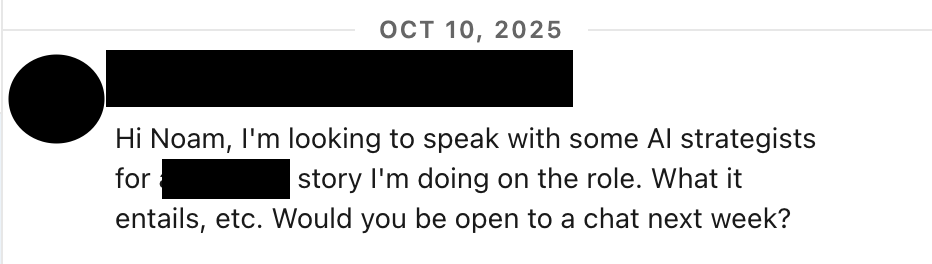
Her first question wasn’t “what do you do all day.” It was something more interesting.
“Why does this role exist?”
I’ve been thinking about that question ever since. Because the answer tells you something important about where organizations actually are right now in their relationship with AI. Not where they say they are. Where they actually are.
The Phase Nobody Talks About
For the last two years, most conversations about AI in marketing have been stuck in one of two places.
Either: “Look what this tool can do.” The demo phase. The excitement phase. The phase where someone shows you something impressive in a meeting and everyone nods and says we should be doing this. Or someone shares what they built using Claude Code over a weekend: an agent that scrapes job listings, tracks market trends, automates a workflow. The reaction is the same: we should be doing this.
Or: “AI is changing everything.” The big picture phase. The think pieces. The conference panels about the future of creativity and the nature of intelligence.
Both of those conversations are real. But there’s a third phase that doesn’t get nearly as much attention.
The operations phase.
This is where most large organizations actually are right now. They’ve moved past the demos. They’ve made the investment. They’ve bought the tools, set the mandates, announced the initiatives. And now they’re sitting with a much harder question: how do we actually make this work?
Not in theory. In practice. With real teams, real deadlines, and real accountability for results.
What Companies Got Wrong
Here’s what most organizations discovered after they bought the tools.
The technology worked. That wasn’t the problem.
The problem was everything around the technology. How do you get a creative team to actually trust a new tool enough to change the way they work? How do you maintain brand voice and quality when AI is helping generate content at scale? How do you know which parts of the creative process to automate and which parts to protect? How do you measure whether any of this is actually improving outcomes, not just increasing output?
These are not questions that come with the software. And they’re not questions that an IT team or a legal team or even a standard change management process is equipped to answer.
They’re strategy questions. Creative questions. Human questions.
And most organizations had nobody whose job it was to answer them.
Why the Role Had to Be Invented
The AI Creative Strategist role exists because companies eventually realized something important: the hard part was never the technology.
The hard part was the human side of the implementation.
Getting a team of experienced creatives to change how they work is not a technology problem. It’s a trust problem. A culture problem. A question of identity: if AI is writing the first draft, what does that mean for what I do and who I am as a creative professional?
Getting a brand to maintain its voice at scale is not a prompt engineering problem. It’s a brand strategy problem. It requires someone who deeply understands what the brand stands for, what it sounds like, and what it would never say, and can translate that into guidance that works across tools and teams.
Getting leadership to understand what “good AI adoption” actually looks like, versus what the dashboard says, is not a data problem. It’s a communication problem.
Someone had to be in the room for all of those conversations. Someone who understood both the creative work and the business outcomes. Someone who could translate between the technology and the people using it.
What This Tells Us About the Market
Here’s the signal worth paying attention to.
When organizations start creating entirely new roles to solve a problem, it means the problem is real, it’s not going away, and the existing playbook isn’t working.
The AI Creative Strategist role is a sign that companies have stopped treating AI as an experiment and started treating it as infrastructure. And infrastructure requires people who know how to build it, maintain it, and make sure it’s actually serving the humans who depend on it.
The organizations that figure this out early, that AI is a people and strategy problem as much as a technology problem, will have a real advantage over the ones that are still trying to solve it with better tools.
What are you seeing in your organization? Are you in the operations phase yet, or still in the demos?

Reply and tell me. I read everything.
Noam