

The Thinking Gap
The Silent Risk Sitting Inside Every AI-Powered Marketing Team

Jenny Fernandez and I had both been noticing something in our work. A different kind of problem. Quieter. Less visible. But in some ways more concerning for marketing and brand teams specifically.
We called it the Thinking Gap.
The Moment That Made It Real
A pattern that went something like this: a team presents a polished report during a planning meeting. The numbers look right. The framing is confident. Then someone asks a follow-up question and the room goes quiet. Not because the team doesn’t know the subject. But because the AI wrote the summary and nobody went back to verify the underlying claims.
One leader put it simply: “We didn’t have a resistance problem. We had a process problem.”
That’s the Thinking Gap. Not laziness. Not incompetence. A missing process.
Why Marketing Teams Are Especially Exposed
This pattern shows up across industries. But I want to talk specifically about what it looks like inside marketing and brand teams, because that’s where I spend most of my time and where I think the risk is most underestimated.
Marketing is a discipline built on persuasion and credibility. The job is to make audiences believe something: that your brand understands them, that your product solves their problem, that your story is true.
When AI is generating the content that carries that story, and nobody is thinking critically about whether the reasoning behind it is sound, you’re not just risking a bad campaign. You’re risking your brand’s credibility.
A wrong claim in a brand campaign, at scale, is a trust problem. And in the AI era, where audiences are already skeptical about whether content is real or generated, trust is the one thing you cannot afford to lose.
What’s Actually Happening Inside Teams
Here’s the pattern Jenny and I kept seeing.
AI-supported work looks polished. Reports are clean. Campaigns are structured. Presentations are well organized. Output quality, on the surface, has gone up.
But when someone asks a team to defend a decision, not summarize one, something shifts. The confidence drops. The reasoning gets thin. The person who wrote the brief can describe what it says but struggles to explain why they believe it.
This happens because AI produces fluent, authoritative-sounding language. And when output sounds authoritative, people stop interrogating it. They edit. They format. They present. But they don’t think critically about whether the underlying reasoning is actually sound.
There is a term for this: workslop. AI-generated output that looks polished but cannot hold up under scrutiny. It is becoming more common as teams learn to move fast with AI and forget to slow down at the moments that matter.
The Distinction That Changes Everything
The teams that get it right have built explicit checkpoints where a human has to actively engage with the output. Not just review it. Engage with it.
Ask: do I actually believe this? Can I defend it if someone pushes back? Have I verified the claims that matter most? Does this sound like our brand or does it sound like every other brand using the same tools?
That last question is the one that matters most for brands. Because if AI is writing your brand story and nobody is asking whether it actually sounds like you, you are not building a brand. You are building noise.
A Practice That Actually Helps
One of the most practical habits Jenny and I have seen work is what we call the Fact Audit.
Before any significant AI-generated content goes anywhere, someone does a focused pass where they specifically look for claims they haven’t independently verified. Not every claim. The ones that would be costly or embarrassing if wrong.
This takes 20 minutes on most documents. But it changes something important: it keeps human judgment active in the process rather than passive. It means that when someone asks a follow-up question, there is a person in the room who actually owns the answer.
For marketing teams, I would add one more layer: a Brand Voice Audit. Before anything goes out, someone who deeply knows the brand reads it and asks: does this actually sound like us? Not just grammatically correct. Actually like us.
That person cannot be AI. It has to be a human who can verify the answer.
The Bigger Question
The skills that matter most in senior marketing roles, synthesizing complex information, making judgment calls, building a narrative that holds up under pressure, are skills that need to be practiced to stay sharp.
If AI is doing that practice for you, those skills get quieter. And at some point, when you really need them, they might not be there.
The goal is not to use AI less. The goal is to use it in a way that keeps your thinking at the center of the work.
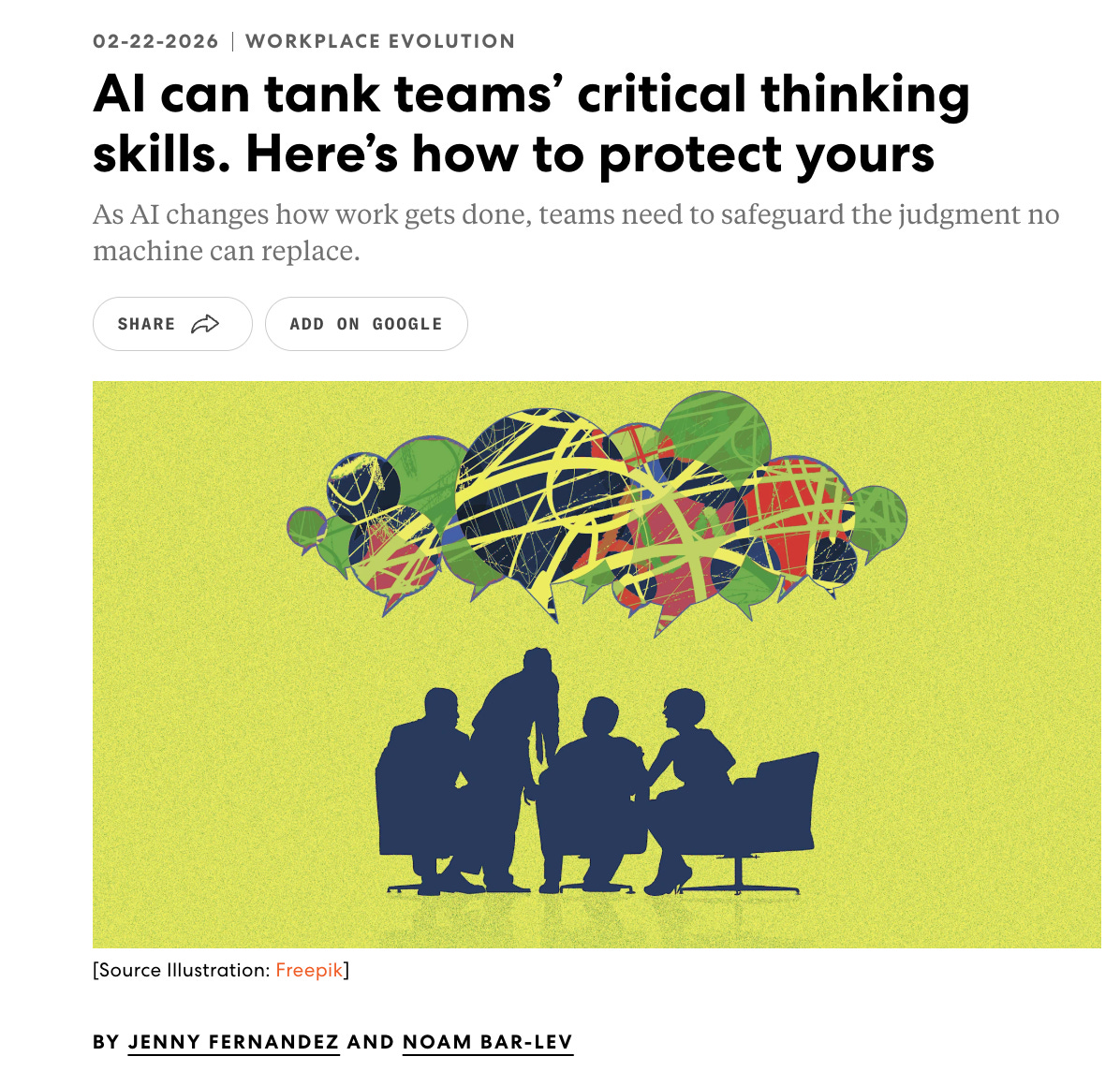
This post is based on research Jenny Fernandez and I conducted for our Fast Company piece “AI Can Tank Teams’ Critical Thinking Skills. Here’s How to Protect Yours.” Jenny Fernandez is a Human Leadership Futurist™ and executive coach who partners with senior leaders to build AI-ready organizations without losing what makes them human. Download her free Personal AI Leadership Readiness Index™ — a research-backed self-assessment that measures your personal readiness for the AI era across four dimensions. She is an adjunct faculty member at Columbia Business School, a TEDx Speaker, and is currently completing her doctorate at the University of Southern California. I’m grateful to think alongside her.
You can read the full piece here.
Do you relate to this challenge?
Reply and tell me what you notice. I read everything.
Noam